A Random Assortment of Us: The Quiet Truth of the Charity Shop Bookcase

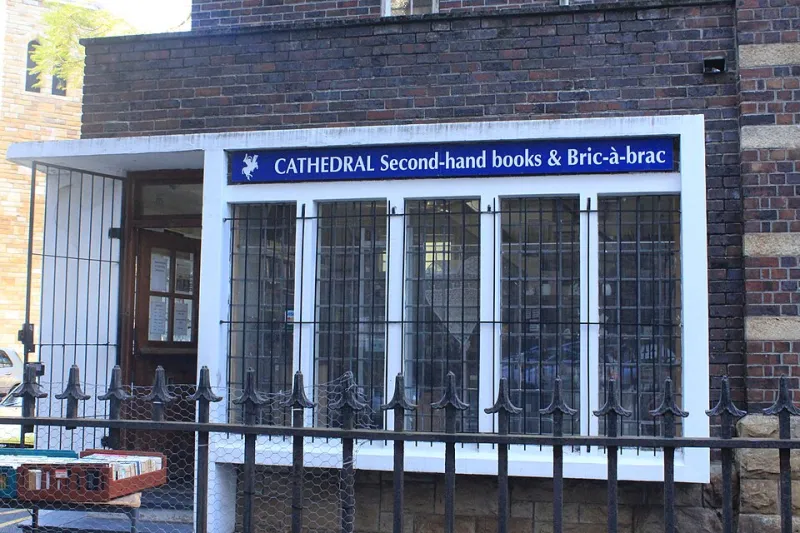
Photo: charity shop bookcase second hand books UK, via sapa-usa.org
It is a Tuesday afternoon in a market town somewhere in the Midlands. The rain is doing that thing where it cannot decide whether to commit. I am stood in the back of a British Heart Foundation shop, in front of a bookcase that leans very slightly to the left, and I am having what can only be described as a cultural experience.
On the top shelf: a 1984 microwave cookbook, a paperback of A Brief History of Time with an unbroken spine, and a copy of The Da Vinci Code that has been read so hard the cover curls like a crisp. Middle shelf: three Jeffrey Archers, a Haynes manual for a Ford Fiesta that no longer exists, and a local history pamphlet called Memories of the Canal. Bottom shelf: a Booker Prize winner from 2007, a Delia Smith Christmas book, and a children's annual from 1991. Price, thirty pence each. Or three for a pound.
This is not a curated selection. It is not a display. It is what happens when a town empties its cupboards and the cupboards answer back. And I think it might be the most honest cultural archive we have.
The Thirty-Pence Canon
We are obsessed with the bestseller list. Every week, somebody tells us what the nation is reading, and every week it is roughly the same mixture of celebrity memoirs, crime thrillers and whatever Richard and Judy have decided to bless. But the bestseller list is a record of intention. It is what people bought, often in an airport, often because the cover was nice, often because they were going on holiday and needed something to read by a pool.
The charity shop bookcase is a record of aftermath. It is what happened next. It is the book you bought, started, and quietly gave up on. It is the cookbook you inherited from your mum and never opened. It is the Booker winner that looked impressive on the shelf and turned out to be a bit of a slog. It is the paperback you read on a train in 1998 and never thought about again until you saw it here, for thirty pence, next to a jigsaw of a cottage.
There is something bracing about that. The bestseller list flatters us. The charity shop bookcase does not. It says: this is what you actually finished. This is what you actually kept. This is what you were actually willing to carry from one house to another, and then, eventually, not.
What the Spines Actually Say
Spend an hour in a few charity shops and patterns start to emerge. Not national patterns, exactly, but local ones. In a seaside town, you will find a lot of sailing guides and a lot of Catherine Cookson. In a university city, you will find theory paperbacks with earnest marginalia and a surprising number of copies of The Female Eunuch. In a commuter town, you will find management books with titles like Eat That Frog! and Who Moved My Cheese? stacked next to a lonely copy of Middlemarch.
None of this is scientific. That is the point. It is anecdotal, random, stubbornly human. It tells you what a place was reading ten or twenty years ago, and what it has stopped reading since. It tells you which books were bought as gifts and never opened. It tells you which local authors sold well in the parish newsletter and nowhere else. It tells you that somebody in this town once owned a copy of The Joy of Sex and decided, on balance, that the charity shop was the right place for it.
I am not arguing that every charity shop bookcase is a museum. Most of it is dross. But that is what makes the good stuff stand out. You find a 1970s Penguin with a cover by David Pelham, or a Virago Modern Classic with a green spine, or a local history booklet that exists in about forty copies and no library catalogue. You find the afterlife of culture, sitting there quietly, waiting to be picked up by someone who did not know they were looking for it.
A More Honest Bestseller List
The publishing industry has spent the last decade telling us that books are back. And they are, in a way. Beautiful hardbacks, sprayed edges, BookTok sensations, the whole thing. But the charity shop bookcase tells a different story. It tells us that most books have a second life, and that second life is often more interesting than the first.
Think about what ends up there. Not just bad books. Good books that have been read and passed on. Booker winners that had their moment and then went quiet. Cookbooks from a decade when nobody was scared of butter. Travel guides to countries that have since changed their names. Self-help books that promised to fix you and did not. The complete works of a novelist who was huge in 1995 and is now remembered mainly by people who work in charity shops.
This is not a failure of culture. It is culture doing what culture does. It circulates. It gets passed on. It gets reread, or not. It sits on a shelf next to a novelty mug and a DVD of Love Actually, and it waits.
Browsing as a Civic Act
In 2026, browsing is underrated. We have spent years being told that the algorithm knows what we want. And maybe it does, in a narrow sense. It knows what we clicked on last time. It knows what people like us clicked on. It knows how to keep us on the sofa.
But the charity shop bookcase does not know any of that. It is not personalised. It is not trying to optimise your evening. It is just a random assortment of things that other people have finished with, arranged by whatever volunteer was on shift. And that randomness is the point. You do not go in looking for a specific book. You go in looking for a surprise. You go in to see what the town has been reading, and what it has decided to let go.
That is a cultural activity. It is not glamorous. It does not come with a press release. But it is free, it is local, and it is genuinely unpredictable in a way that most of our culture is not. It is also, if we are honest, one of the last places on the high street where you can spend a pound and come out with three things to read.
So yes, defend the charity shop bookcase. Not because every book on it is good, but because the whole messy, scuffed, leaning-to-the-left thing is good. It is a record of us. It is a record of what we read and what we could not be bothered to finish. And it is sitting there, right now, in a shop that smells faintly of old paper and furniture polish, waiting for someone to have a look.