The Last Unranked Feed in Britain Is Made of Cork
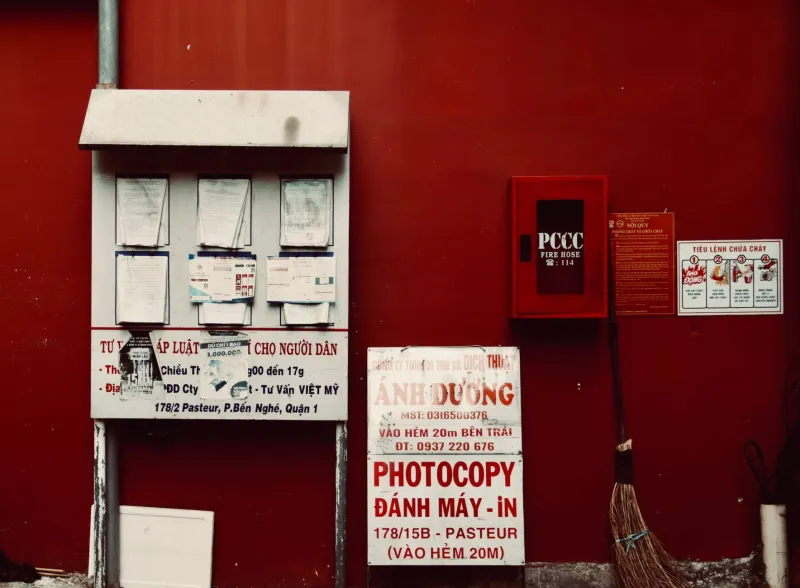
It is twenty past four on a Thursday in November, and the light has already given up. I am standing in front of a noticeboard outside the village hall, next to a dog waste bin, reading about a lost cat. The cat is called Biscuit. Biscuit has been missing since Tuesday. The poster has a photograph printed on ordinary A4, one corner curling away from the glass like it is trying to leave too. I do not know Biscuit. I will probably never meet Biscuit. But I read the poster twice.
This is not an emergency. It is not even news. But it is information, and it has been pinned there by a person, for other people, in a specific place. No one has asked me to accept cookies. No one has inferred my location from my IP address. No one has decided that because I once clicked on an article about cats, I might like to see more cats, or a cat food advert, or a cat food advert disguised as an article about cats. The board does not know me. That is its first great quality.
The board does not know you
A feed is built on the promise of relevance. It watches what you pause on, what you skip, what you share, and it builds a version of you that it can serve. The noticeboard has no such ambition. It has a pane of glass, a wooden frame, and a collection of pins. It does not rank. There is no 'For you'. There is a lost cat, a Wednesday Pilates class, a parish council agenda, and a leaflet for a quiz night at the Royal Oak with a tear-off phone number that nobody has torn off. The board does not care whether you are interested. It simply stands there, in the damp, waiting to be read.
That sounds like a limitation. In practice, it is a relief. The board is not trying to keep me scrolling. It is not trying to sell me anything, although the Pilates class is £7 and you do need to bring a mat. It is not measuring my attention. It is just a public square made of cork, and I have chosen to stand in it.
A hierarchy of pins
There is an etiquette to a noticeboard. Blue-tack is amateur. Drawing pins are serious. A laminate is aspirational. A5 flyers with tear-off tabs are optimistic, and the tabs that remain tell you something about the event's reach. The board is a small physical archive of local effort: someone typed the parish council minutes, someone stapled them, someone walked down here in the rain to pin them up. The clerk's email address is probably a Hotmail account. The agenda will mention the church hall roof fund and a planning application for a conservatory. Nobody reads the minutes until something goes wrong, and then suddenly everyone knows exactly which page they were on.
Position matters. Newer notices sit on top. Older ones migrate downwards or sideways. A poster for a Christmas fair in August is an act of optimism; a poster for a summer fete still hanging in November is an act of neglect. There is no algorithm here, but there are editorial decisions. Someone has moved the missing dog notice to the back to make room for a wreath-making workshop. Someone else has put a fresh A4 over the top of the pothole report. That is not ranking. That is just a thumb and a pin, and it is gloriously human.
What the board knows that the feed does not
The feed promises relevance and delivers scale. The board promises nothing and delivers locality. It tells you that the mobile library comes on alternate Tuesdays. It tells you that the church hall roof fund is £400 short. It tells you that Jan from number fourteen is doing a sponsored walk for the hospice, and that the Brownies are collecting tins for the food bank. It does not have comments. You cannot reply. You have to turn up, or ring the number, or ignore it entirely. That is a different kind of engagement. It is not frictionless. The friction is the point.
The board is not neutral, of course. Someone chose what goes on it. There is a gatekeeper, probably a volunteer with a key and a short temper for blue-tack. But it is not ranked. There is no engagement metric. A poster stays until it falls off or someone takes it down. That is a strange and quietly radical kind of democracy, and it is disappearing from fewer places than you might think.
The November pilgrimage
Reading the board under a streetlight in November is a cultural act. You are not scrolling; you are standing still. You are cold. You can hear a car door and a dog barking somewhere behind the church. The glass reflects your face back at you, half-lit, slightly confused. You read the same things you read last week, plus one new thing: a leaflet for a wreath-making workshop with a mince pie included. You think about going. You won't. But you might. That is the board's power. It plants small maybes. The algorithm plants big maybes and then sells you something. The board just pins a possibility to cork. It costs nothing to read. It costs nothing to ignore.
I am not saying the noticeboard replaces the internet. It doesn't. It can't. It is not accessible to everyone, and it is easy to romanticise a piece of cork because it does not have a cookie banner. But there is something worth defending in a public information source that does not optimise. It does not care if you click. It does not know you. It just stands there, under a streetlight, with a curling cat and a Wednesday Pilates class. That is not a feed. It is a place. And in November, that is enough.