The Free Seat Under the Iron Roof: Why the Park Bandstand Still Belongs to Everyone
The first thing you notice is not the music. It is the lack of a gate. You walk into the park, follow the sound of a tuba being tuned, and sit down. Nobody checks a QR code. Nobody asks whether you have booked a slot. There is a bandstand, a cluster of benches, a few people with flasks and a dog that has clearly been to better concerts. This is the municipal Sunday concert, and it is still happening.
I have been thinking about bandstands a lot this autumn, partly because the world keeps trying to sell me culture in a box. A ticket, a time slot, a barrier, a bag search, a £9 pint. The bandstand offers the opposite deal: turn up, sit down, listen for an hour, go home. It is not a festival. It is not an experience. It is just a thing that happens in a park, for free, because somebody decided it should.
The venue that asks nothing of you
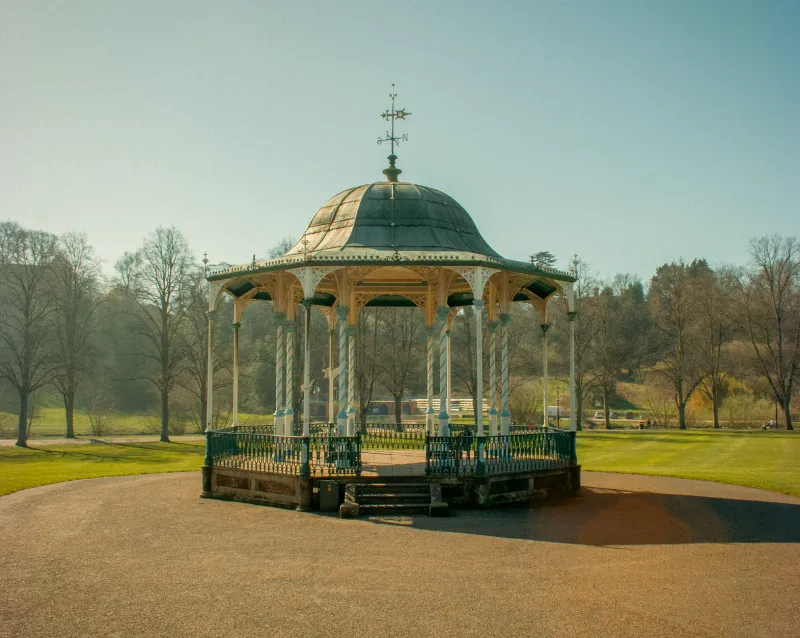
A bandstand is a strange piece of architecture when you look at it properly. Half shelter, half stage, it was designed for British weather rather than Instagram. The roof keeps the brass players dry. The open sides let the sound out. The raised floor gives the band a bit of authority without putting them behind a security cordon. It is civic infrastructure dressed up as a gazebo.
The ones that survive are often lovely without being precious. Brighton’s seafront bandstand, Southsea’s by the Common, the one tucked into Sheffield’s Botanical Gardens, the ironwork at Eastbourne’s Devonshire Park, Kelvingrove in Glasgow — they are all slightly different, but they do the same job. They create a room outdoors where nobody needs a reason to be there.
That matters more than it sounds. Most cultural venues ask you to qualify yourself. You need to know about the band, or the play, or the exhibition. You need to have chosen it. The bandstand asks nothing. You can wander in during the second number, leave during the fourth, clap in the wrong place, or ignore the music entirely and read the paper. It is the least exclusive arts venue in Britain, and it is not trying to be anything else.
A very British kind of staging
The municipal concert is a survivor of an older idea: that local authorities should provide not just bins and benches but a bit of public pleasure. Victorian parks were built with bandstands because music in the open air was considered improving, healthy and, crucially, cheap. Brass bands came out of workplaces and chapels and coal mines. The whole thing was popular culture before the phrase existed.
Now the programming is more mixed. On any given Sunday you might get a brass band, a community choir, a ukulele group, a jazz quartet, a school orchestra or a tribute act doing Abba with more enthusiasm than accuracy. The standard varies. That is part of the point. A free concert can be a bit rough around the edges because nobody has paid £60 to be disappointed. The audience is not a market. It is a crowd.
At Southsea I watched a band launch into a medley of show tunes while a toddler conducted from the grass and an older couple unpacked sandwiches from a Tupperware box. At Brighton, the wind did its best to remove the sheet music. At a smaller bandstand in a Midlands park, the audience was roughly fifteen people and two dogs, and the band played as if the Albert Hall was watching. There is no irony in that. It is just what happens when people agree to do a thing together.
What the volunteers are actually keeping alive
The volunteers are the ones who make it look easy. Friends groups, local brass band committees, park rangers, the person who books the acts and the person who remembers the key for the storage hut. They chase permits, fill in risk assessments, mend the PA, put out the chairs, and stand by the collection bucket hoping nobody feels obliged.
It is not glamorous work. Councils have squeezed parks budgets for years, and the bandstand is exactly the kind of thing that looks easy to cut because it does not produce a headline. But the volunteers I have spoken to are not sentimental about it. They talk about footfall, about families who stay in the park longer, about older people who come out on a Sunday because they know there will be a seat and a tune. They talk about the bandstand as a reason to leave the house.
That is the bit the spreadsheet misses. A free concert does not just entertain the people who watch it. It gives the park a purpose on a day when it might otherwise be empty. It gives local musicians a stage. It gives a high street somewhere to send people after the shops close. It is small, but it is not nothing.
The economics of a free afternoon
Compare it with the ticketed festival. I like a festival as much as anyone, but the model is increasingly absurd: pay hundreds, book months ahead, queue for everything, stand in a field, pay again for food. The bandstand offers a different arithmetic. You walk in. You sit down. You might buy an ice cream from the kiosk. You are home by five. The cost per listener is tiny, and the barrier to entry is roughly zero.
That does not mean it is free to run. Someone pays for the maintenance, the insurance, the licensing, the band’s petrol money. But the municipal concert is still one of the best-value cultural interventions we have. It does not require a new building. It does not need a marketing campaign. It needs a bandstand that is not falling down, a programme, and a few people willing to keep the thing going.
Why the lack of a headliner matters
The bandstand has no headliner, and that is its secret. There is no rush for the front row. No one is filming the whole thing on their phone. No one has paid extra for early entry. The audience is a random assortment of the local population, which is what a park is supposed to be. You get people who know the band and people who just heard the noise. You get kids dancing and adults pretending not to. You get a shared hour without a transaction.
In a culture that increasingly treats attendance as a transaction, that is quietly radical. The bandstand says the opposite: this is yours because you are here. You do not have to be a customer. You do not have to be a fan. You just have to be in the park on a Sunday.
The threat is not that people have stopped liking brass bands. The threat is tidying up. It is the temptation to turn every free event into a ‘destination’, to fence it, brand it, charge for it, or replace it with something that looks better on a funding form. The bandstand does not need to be modernised into a mini-festival. It needs to be left alone enough to keep being ordinary.
So next Sunday, if you pass a park and hear a tuba, go and sit down. Take a flask if you have one. Clap when the conductor turns round. Put a quid in the bucket if you can. The municipal bandstand is not a heritage attraction or a lifestyle trend. It is a free seat under an iron roof, and it belongs to everyone.