Please Sit Down: The Small Brass Truth of Britain’s Memorial Benches
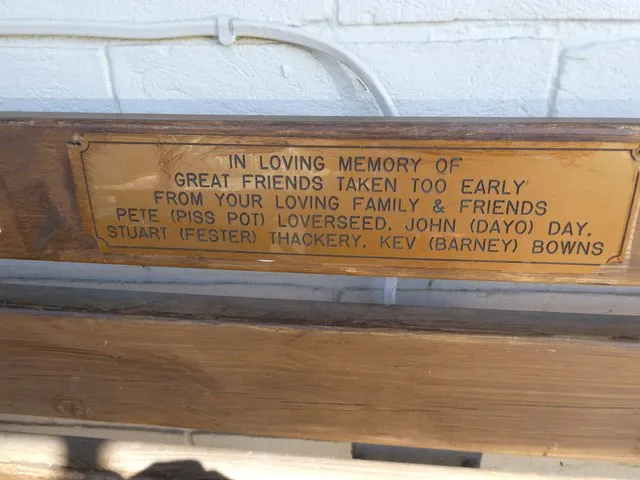
Photo: Jeremy Bolwell , CC BY-SA 2.0, via Wikimedia Commons
There is a bench near the end of a promenade I know, positioned so you get the sea if you look one way and a car park if you look the other. The plaque says: In memory of Alan, who sat here every morning and complained about the weather. 1938–2019. I never met Alan. I still think about him when it rains.
That is the strange power of the memorial bench. It is not a statue. It is not a blue plaque on a house nobody can afford to visit. It is a piece of public furniture with someone's name on it, and it asks nothing of you except that you might, if you fancy, sit down.
We are quite good at this in Britain. We are less good at saying why it matters.
A brass rectangle is a small act of citizenship
Most public art is commissioned by committees. It arrives with a press release, a title involving the word 'dialogue', and a local councillor standing slightly too close to it. The memorial bench is different. It is usually paid for by a family, or a group of friends, or a widow who wants somewhere to go on a Sunday. It is installed with a minimum of fuss and a maximum of screws. It is, in the truest sense, art for people who would never call themselves art people.
And it is useful. That sounds like a low bar until you remember how much public art you cannot sit on. A bench with a plaque is a seat, a notice and an invitation in one. It says: this person was here, this view mattered to them, and you are welcome to share it. There is no gift shop. There is no audio guide. There is just a slat of wood and the weather.
The plaques are also a kind of distributed obituary. They tell you about ordinary lives in a way that official records rarely do. Here was a man who loved this canal. Here was a woman who fed the ducks. Here was someone's nan, who sat here every Thursday and did not want to be disturbed. These are not grand claims on history. They are small claims on a place. They are, in their way, more honest than most memorials because they admit that remembrance is often local, specific and slightly eccentric.
The spreadsheet is not the enemy, but it is not the whole story
In 2026, councils are under pressure. That is not news. Maintenance budgets are tight, risk assessments are real, and a bench that is rotting at the joints is a genuine liability. I am not the person who wants to pretend that a parks department can run on sentiment alone. If a bench is unsafe, it should be fixed or removed. If a plaque is illegible, it should be cleaned. If a lease has expired, someone has to make a decision.
But the way we talk about memorial benches often reveals what we value. They get filed under 'street furniture' and 'asset management'. They appear in spreadsheets as items to be inspected, replaced or decommissioned. That is fair enough. The trouble is that a spreadsheet cannot see the difference between a bench and a bench with a name on it. A clipboard cannot tell you that someone drives forty minutes to sit on a particular seat on a particular date because it was their dad's birthday.
Some councils run memorial bench schemes with clear terms: you pay for the bench and the plaque, and you get it for a set number of years. That is sensible. But when the term ends, the plaque often comes off and the bench carries on as anonymous furniture. Sometimes the bench itself disappears. Sometimes it is replaced with a backless metal perch that looks like it was designed by someone who has never been tired. The family is told, politely, that the scheme has changed.
I understand why. Councils cannot keep every plaque in perpetuity. They cannot promise maintenance forever. But there is a middle ground between 'forever' and 'bin it'. A plaque can be re-mounted on a new bench. A register can be kept. Families can be given the chance to renew. The bench does not have to be a permanent legal obligation to remain a meaningful public object. It just needs someone to treat it as more than a line item.
What we owe the bench in 2026
We owe memorial benches a bit more imagination. They are one of the few forms of public remembrance that ordinary people can actually commission. You do not need a trust, a curator or a fundraising campaign. You need a council form and a few hundred quid. That accessibility is worth protecting. It is also worth improving. The plaques should be legible. The benches should be comfortable. The process should be clear. And when a bench reaches the end of its life, the plaque should not be treated like a crisp packet.
We also owe them a bit more attention. Next time you see one, read the plaque. Not in a morbid way. Just read it. You will learn something about the street you are standing on. You will learn that someone loved this view, or this park, or this patch of grass. You will learn that the person who sat here was not famous, and that is precisely the point. Most of us will never get a statue. A bench is a more realistic ambition.
And yes, sit down. That is what it is for. The person whose name is on it is not going to mind. They probably would have liked the company.